MEN WHO SAID NO | ROAD TO CONSCRIPTION | OBJECTION | PRISONS | SENTENCED TO DEATH | TRIBUNALS | WIDER CONTEXT |
|
| Back | Home |
MEN WHO SAID NO | ROAD TO CONSCRIPTION | OBJECTION | PRISONS | SENTENCED TO DEATH | TRIBUNALS | WIDER CONTEXT | |
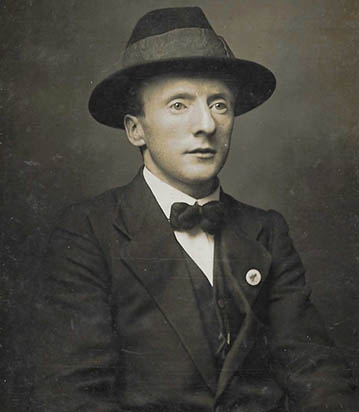
| VALE WILLIAM RAWLINGS 1887 - 1940 |
|
||||||||
|
Vale Rawlings was four feet 11 inches tall. He weighed seven stones, had a 32-inch chest, a congenital heart defect and severe rheumatism. Should he ever have been called up for active service? It seems unlikely. The minimum height for the regular Army didn’t drop below five feet two inches in World War One. Even the Bantam Battalions, which smaller men could volunteer to join, wanted men who were five foot tall or more. Vale was born in Burton upon Trent, Staffordshire, on December 28th, 1887. He was one of seven children whose father, Richard, was a domestic coachman who transported two local doctors around the town in a horse and carriage. His mother Maria had the innovative idea of starting a tuck shop in the front room of the family home in Bond Street to provide snacks and treats for pupils attending Burton Boys’ Grammar School directly across the road. Vale joined the Independent Labour Party in 1906 and soon became Secretary of its Burton branch. In 1911 he was instrumental in the formation of the first branch of the Workers’ Union in his home town and began to campaign for better wages, terms and conditions for labourers in the town’s breweries. He also spoke out in favour of universal suffrage – votes for all adult men and women - and opposed the National Service League, a pressure group campaigning for compulsory military training. By the end of 1913, through his persistence as a committed activist and honorary secretary of the Burton branch, he had played a major role in securing the first minimum wage of 23 shillings for the town’s unskilled brewery workers alongside a fixed 54-hour working week. In the summer of 1914, his name became known across the country after he supported some 40 female workers from a newly-established flypaper factory, many of them aged 13 to 18, who went on strike after they realised that most of them were taking home between 2/6 and 3/9 a week on piecework rates for a 55-hour week rather than wages of between 10 and 15 shillings which they said they had been promised. On June 11th at about 2pm, Vale was speaking to a group of 10 to 15 young women strikers picketing the factory when a six-feet-tall police inspector, accompanied by two constables, walked down the street. After a cursory exchange of words, Vale was arrested and taken to Burton police station where he was charged with assault for punching the Inspector in the chest. Vale always denied the charge and many eye-witnesses (not all of them involved in the strike) also denied any assault took place. Some pointed out that Vale had a sheaf of papers in one hand and a pencil in the other and in court none of the three officers were able to say with which hand Vale struck the inspector. On the day of the trial a non-striking factory girl also claimed Vale assaulted her by knocking her into a wall but later admitted the factory manager had insisted she brought the case and had paid for the summons and arranged for the inspector to help her with her evidence. Vale was found guilty of both assaults and opted to take a 21-day prison sentence rather than pay the fines and costs. The case was raised several times in the House of Commons by Labour Party founder Keir Hardie, who also came to Burton to speak to an audience of thousands of people about the case. He and other MPs, including Charles Bowerman, Philip Snowden and Charles Duncan, urged the Home Secretary Reginald McKenna to order a retrial because of inconsistencies in the evidence. Most newspapers in the country covered the case and eventually, after receiving a 10,000-signature petition supporting Vale and demanding a retrial, the Home Secretary agreed to make the two sentences run concurrently rather than consecutively meaning that Vale came out a week early to a hero’s welcome. The press estimated that a total of 15,000 people either lined the route of a celebration procession through Burton upon Trent or congregated in the market place and surrounding streets to hear Vale speak. After World War One broke out, weeks later, Vale regularly spoke at public meetings saying that working-class men across Europe had no quarrel with each other and had been forced into this conflict by their squabbling ruling classes who were determined to build the wealth, power and prestige of their own empires. Earlier that year, he and his colleagues had forged bonds of friendship with workers in German breweries and had been exchanging information about their respective campaigns to improve health and safety and achieve fair wages and hours. It was unthinkable to Vale that men from Burton upon Trent should be told to attack and kill men with whom they had so much in common. They all shared the same dreams and ambitions and wanted to build better lives for themselves and their descendants. In late 1914, Vale became an insurance agent for the Birmingham-based Planet Friendly Assurance Collecting Society, which was managed and owned by a Labour co-operative. He also volunteered in his free time with the Burton upon Trent Voluntary Aid Association, trying to ease distress and avert crises faced by the elderly, disabled, sick and poverty-stricken of the town. Although he was a committed conscientious objector, and joined the No-Conscription Fellowship, he respected those who chose a different path and devoted hours to securing prompt payment of military allowances to women whose husbands were Workers’ Union members who had volunteered to serve. He had friends and relatives who joined the forces and correspondence between them shows they respected each other’s views. At this stage, they probably felt Vale’s ill-health and small stature would mean he would never be asked to serve anyway. When conscription was introduced, Vale became a supporter and advocate for men taking their cases to the local military tribunal asking to be exempt on religious or conscientious grounds or because of personal hardship, ill-health or because their work made them indispensable. He was also outspoken against profiteering and sought, through the local Co-operative Movement, to achieve access for all to food at fair prices. He also campaigned against rent rises, which he said were hitting families whose loved ones were fighting for their country. He led fundraising efforts for the St Dunstan’s Hostel for Blinded Soldiers and Sailors. In June 1916, Vale’s call-up papers arrived. His employers, the Planet Friendly Society, put in a claim for him to be exempt from service as they felt he was doing work of national importance for them. Like his family, they also probably thought that once he was medically examined the authorities would realise he was not fit to serve. Vale was examined by No. 1 Medical Board, Curzon Hall, Birmingham, on behalf of his employers, on August 24th, 1916. The report recorded that he was four feet 11 inches, had a 32-inch chest, weighed seven stones and was in ‘poor’ condition. It then categorised him as Class A. Fitness categories ran from A (‘fit enough to withstand active service conditions’) through to D (‘unfit to serve’) with B and C in the middle. Vale’s family, he was married now with a baby daughter, were astonished and angry. On November 11th, 1916, Vale travelled to Holborn Hall in London for a pacifist meeting which was raided by police and Army officials in one of the regular ‘round-ups’ looking for men who were evading conscription. The Army officer in charge that night took one look at Vale and told him to ‘run off home’. He clearly thought him an unsuitable candidate for the Army. Now it was time for Vale to fight his case at the local military tribunal. The military representative on his tribunal panel was former Burton Mayor Charles Harrison who had also been one of the three JPs on the bench for the ‘flycatcher girls’ trial. Did the humiliation he and his colleagues had suffered through publicity about the controversial court case influence his opinion? The card bearing his verdict on Vale Rawlings appeal (case number 2230) is still held at Staffordshire Record Office. It said: ‘I object to any exemption in this case on the grounds that it is no longer expedient in the National Interest that the applicant should remain in civil employment.’ signed by ‘Chas Harrison, Military Representative’, January 26th, 1917. In his arguments to the local military tribunal, Vale focused on his political and moral objections to the war but also spoke about his voluntary work through the union and other charities as well as his day job with the Planet. The Planet eventually withdrew its claim for Vale. It was told it could only keep a limited number of insurance agents and felt older workers, who had been employed by them for longer than Vale, had a stronger claim. On his form to the local tribunal, Vale explained that he would oppose non-combatant service if it was offered. He wrote: I object to non-combatant services on the same grounds as I do to combatant; both are parts of a military machine which not only does not settle either national or international disputes but creates further need for militarism, as in the case of the ‘preparedness’ campaign in America. The same argument will apply if it is left to the belligerents to settle the question of Constantinople and the Straits according to the speeches of their statesmen. In this way non-combatant, equally as well as combatant service, perpetuates militaries and above all destroys the possibility of the Brotherhood of Nations and the Unity of the Workers of the World. He said he objected to the use of arms to settle any dispute, even if the cause was just, and said he had held conscientious objection views since he first became a ‘conscious socialist’ around 1906, ‘…when I decided to consecrate my life to the aims of socialism by joining the Independent Labour Party’. MP Philip Snowden, who believed that genuine conscientious objectors should be exempt from service, provided a written testimonial saying he knew Vale had held pacifist views and been openly opposed to militarism long before the war broke out. However, despite all Vale’s arguments, and fortified no doubt by the medical board’s Class A categorisation, the tribunal decided that Vale should serve with the Non-Combatant Corps (NCC). Vale appealed to the county tribunal, but had to send in a doctor’s sick note when an initial date of March 12th, 1917, was set, as he was suffering from rheumatism and heart complications following a serious bout of flu. He dictated a letter for his wife to send with the sick note, where he pointed out that the letter summoning him to the appeal hearing was addressed to a Mr W R Bale, which he assumed was him. When the county appeal tribunal sat, it said it accepted he was a genuine conscientious objector, but he must serve with the NCC. Vale wrote another statement in a bid to secure a hearing with the central appeal tribunal in London. He wrote: I cannot accept the decision of the Appeal Tribunal as nothing less than Absolute Exemption will meet my convictions. Both the Local and Appeal Tribunals have fully recognised the genuineness of my conscientious objection; as stated by the Chairman of the Local Tribunal and in a letter from the Appeal Tribunals, copy of which I append. The Appeal Tribunal appear to have ignored my answers to the Statutory Questions which clearly established why I could not accept Alternative Service. In my statement before the Appeal Tribunal I drew attention to the fact that in June 1914 in a charge of assault on the police brought against me, the charge being false, I refused to accept the decision of the magistrates in imposing a fine and went to Gaol as a protest against it, with the result that the whole town was stirred and the Home Secretary was induced to release me. I adduced this as evidence of my readiness to stand by them [his principles] no less strongly in the matter of Military Service and therefore can accept nothing short of an Absolute Exemption. Finally, I desire to say that neither the tribunals nor their Military Representative can have failed to notice my height (which is four foot eleven) and physical condition (I weigh seven stone) and the medical evidence submitted that I have recently suffered from severe rheumatism for several months. The same doctor has attended me since childhood for cardiac disease and recently told me I was ‘no earthly use to the Army whatever’. I therefore hold that I am entitled to hold fast to my opinion and claim Absolute Exemption from Military Service, especially considering the nature of my work as referred to in my answers to the statutory questions. Vale was refused permission to make the third-tier appeal and was sent a letter on April 5th, 1917, ordering him to report for duty. He ignored it. He was sent another on April 9th, which was followed quickly by his arrest. He appeared at Burton Police Court on April 10th, 1917. Burton butcher Alderman Arthur Roberts, another one of the JPs at Vale’s 1914 trial, was on the bench this time. Vale was charged with being an absentee since 5th April under the Military Services Act 1916. Asked if he pleaded guilty or not guilty, Vale said, ‘I don’t regard myself as a soldier and it is immaterial to me.’ Vale was fined £3 and handed over to the military authorities. As he left the dock he said, ‘I don’t know where you will get the money from.’ He was taken to Lichfield Barracks. Because of his immediate refusal to co-operate, dress in a uniform and go on parade, he was charged with disobeying a lawful command and put in the guard room. On 12th April, Vale was dragged out of the guard room by a sergeant and struck, although the sergeant did later apologise. Vale would have known that continued refusal to obey orders could only result in a court martial with imprisonment the inevitable result. Back home, his wife was expecting their second child. His sister Lily replaced him as secretary of the No. 1 branch of the Workers’ Union and began a correspondence with MP Charles Duncan, also General Secretary of the Workers’ Union, calling on him to intervene on Vale’s behalf. Austin Smith, a close friend and union colleague of Vale’s, focused his letter-writing campaign on MP Philip Snowden, who agreed that forcing Vale to serve in the NCC was ridiculous given his height, ill-health and general frailty. A few weeks earlier, Philip had spoken in the House of Commons and submitted evidence to the War Office alleging that the Army was pressing into service tens of thousands of men who were medically unfit. During a debate on the Military Service (Review of Exceptions) Bill, Philip cited examples of men with heart disease, consumption and other chronic conditions being called up and dying in service within days or weeks. Austin and Philip believed that Vale was another such case. Austin and Lily also believed that Vale was deliberately targeted because he had made such a nuisance of himself down the years campaigning for the working man and woman and embarrassing the authorities. Philip submitted details of Vale’s case to the Secretary for War, but meanwhile, on April 14th, Vale was sent from Lichfield to the South Camp at Ripon, Yorkshire, which was the base of the 67th Training Reserve Battalion to which the 6th North Company NCC was attached. Vale wrote to Austin that, on arrival at Ripon, he was taken before a commanding officer who said that he would like to give Vale 20 lashes and Vale ought to have a rope around his neck. Unintimidated, Vale said he would continue to disobey as before. He told Austin he was delighted to have met two more conscientious objectors in the guard room at Ripon. One was Richard Evans from the Fellowship of Reconciliation (FOR), who had previously travelled to Burton upon Trent to speak. In his letters, Vale was full of praise for the soldiers from Scottish regiments who were stationed at Ripon. He singled out one pro-war guard in particular with whom he enjoyed lively, good-natured debates. As had been the case at Lichfield, Vale was not given a bed and had to sleep on the floor just on a blanket. Vale wrote: ‘I cannot be on my right side for long because of the aching pains I get in my shoulders, but I do not complain. My wrist swells a little at times and aches but it is worth it all.’ One night, a drunken Royal Artillery soldier was put into the guard room where Vale and Richard Evans were trying to sleep on the floor. Richard heard the sergeant of the guard tell the drunken soldier that they were both conscientious objectors. After the door shut, the soldier began questioning Richard Evans and then said, ‘Won’t you fight then? Fight me,’ and he pulled the blankets off Richard and struck out at him. Richard dodged out of the way, and the drunk tried a few more times before turning to Vale. He hit and kicked Vale as he lay on the floor, landing a number of blows to his body, head and back. Vale protected his face with his hands and said he was fortunate that the guard had taken the soldier’s boots off him. The guards came into the room, and in their presence, the drunk rushed at Richard again before he was grabbed by the guard and taken away. Vale made an official statement of complaint about the incident, which concluded with these words: I have no vindictiveness against the soldier because he was drunk but I think there was a plot at the bottom of it re the Sergeant’s conversation and the Guard’s general attitude here. This incident was probably the spur for Austin to write to Gladys Rinder at the Conscientious Objectors Information Bureau in London. From her reply, it’s clear he’s asked about escalating the report of Vale’s treatment and his fears that Vale could be killed. She wrote: Dear Comrade, I think you will find that Mr Snowden [Philip Snowden MP] will himself put a question in the House about the case of Vale Rawlings if he thinks it is advisable, but it could do no harm for you to make the suggestion. I will pass on particulars of this occurrence to Mr Ammon. I do not think you need fear that he will be killed, but certainly the facts about his treatment should be brought to the notice of the authorities. Around this time, Vale’s wife Nell wrote to the military authorities: I want to know what I and my child are to do when you have killed my husband by keeping him in the guard room of the 69th T RB South Camp Ripon. He has only just recovered from a very serious illness rheumatism, cardiac d [disease] with influenza, this lasting 14 weeks and his doctor thought he would never pull him through. Now he writes me he has had another serious heart attack and it will certainly be murder if he is kept there in this condition. Why don’t you discharge him? He will never be of any use to you. He is only 4 feet 11 high and strength to match. Of course the doctor that passed him in Class A is a fool, or as the soldiers tell my husband at Ripon, must have been drunk. He has suffered from heart trouble ever since I have known him, which is many years, and only last year his doctor of Lichfield Street, Burton on Trent, refused to certify him sound for a life insurance because of his heart. You will find my husband under the name Vale W Rawlings. Her words clearly had no impact because Vale was court-martialled for refusing to follow orders while in the NCC. He was sentenced to two years’ hard labour and sent to Wormwood Scrubs in London on May 3rd, 1917. On May 17th, due to his continued ill health, Vale was placed on ‘half-task’ by the senior medical officer at Wormwood Scrubs Prison. He was examined by the same medical officer on May 31st who certified that Vale suffered from ‘valvular disease of the heart’. He also expressed surprise that Vale had been passed Class A by the Birmingham Medical Board. On June 17th, 1917, the same medical officer informed the War Office that Vale had ‘mitral obstruction and was quite unfit for hard work’. Despite this, on July 19th, Vale was transferred to the Princetown Work Camp at Dartmoor – the former Dartmoor Prison now re-purposed for Conscientious Objectors. Not all would accept a transfer there, but Vale did, perhaps thinking it was preferable to prison life. However, his health continued to worsen and he spent much time in the camp hospital. Finally, he was sent home on the grounds of ill-health on September 17th, 1917. His discharge papers described him as five feet four inches. Was this a clerical error, or were they trying to disguise the fact that they’d locked away a man for more than five months who should never have been called up in the first place? After the war working-class men finally had the vote – but Vale had to wait as he was struck off the register of electors because of his court martial. When he did have the right to vote again, he stood for the local council and was elected at his third attempt. Perhaps ongoing prejudice against conscientious objectors played a part in his first two failures? During six years on the council he campaigned successfully for more, high-quality council homes, better roads and improved sewerage systems and health facilities in villages. He ran a small market garden and grew fruit and vegetables that he sold locally, but was always keen to give produce away to families in need. Health problems continued to beset him, but he still travelled around the country supporting Labour MPs standing for election and after moving from the ILP to the Labour Party he became secretary of the Burton Constituency Labour Party. His final illness confined him to bed for a lot of 1940. He lived to see his son-in-law Arthur Taylor jailed for being a conscientious objector in World War Two. Arthur had married Vale and Nell’s eldest daughter Enid, the baby Nell was left holding when Vale was jailed in 1917. One of Vale’s sons, Ken, also faced a military tribunal on June 12th, 1940. He said he’d been a vegetarian since he was eight years old, and he couldn’t take the life of an animal, much less a human. He did agree to undertake non-combatant duties, and the tribunal registered him for service in the Royal Army Medical Corps (RAMC). Vale died on Christmas Eve, 1940, and was buried four days later, on what would have been his 53rd birthday. Vale’s forgotten story was discovered in 2023 by Burton-based writer Elaine Pritchard. She and Will Walker, secretary of East Staffordshire Trades Council, formed The Vale Rawlings Project CIC which now raises awareness of Vale’s life and times and raises money for two local charities that continue the work he did in his lifetime. They are YMCA Burton and SARAC (Sexual Abuse Rape Advice Centre). Elaine wrote a play, Strikers! that was performed in Burton Town Hall (where Vale spoke many times) in December 2024. As a result, councillors of all political parties on East Staffordshire Borough Council voted to rename a public room in the town hall The Vale Rawlings Room. Elaine has written a book, Friendship, Love & Truth, about Vale which was published in late 2025. All profits from the book will go to the two charities.
Read more about Vale Rawlings, the book, the play and the man himself, at www.forgottenburthstories.co.uk
|
|
||||||||
|
|||||||||
 |
|||||||||